
Thinking Beyond Today: Driving Africa’s Next Wave of Growth
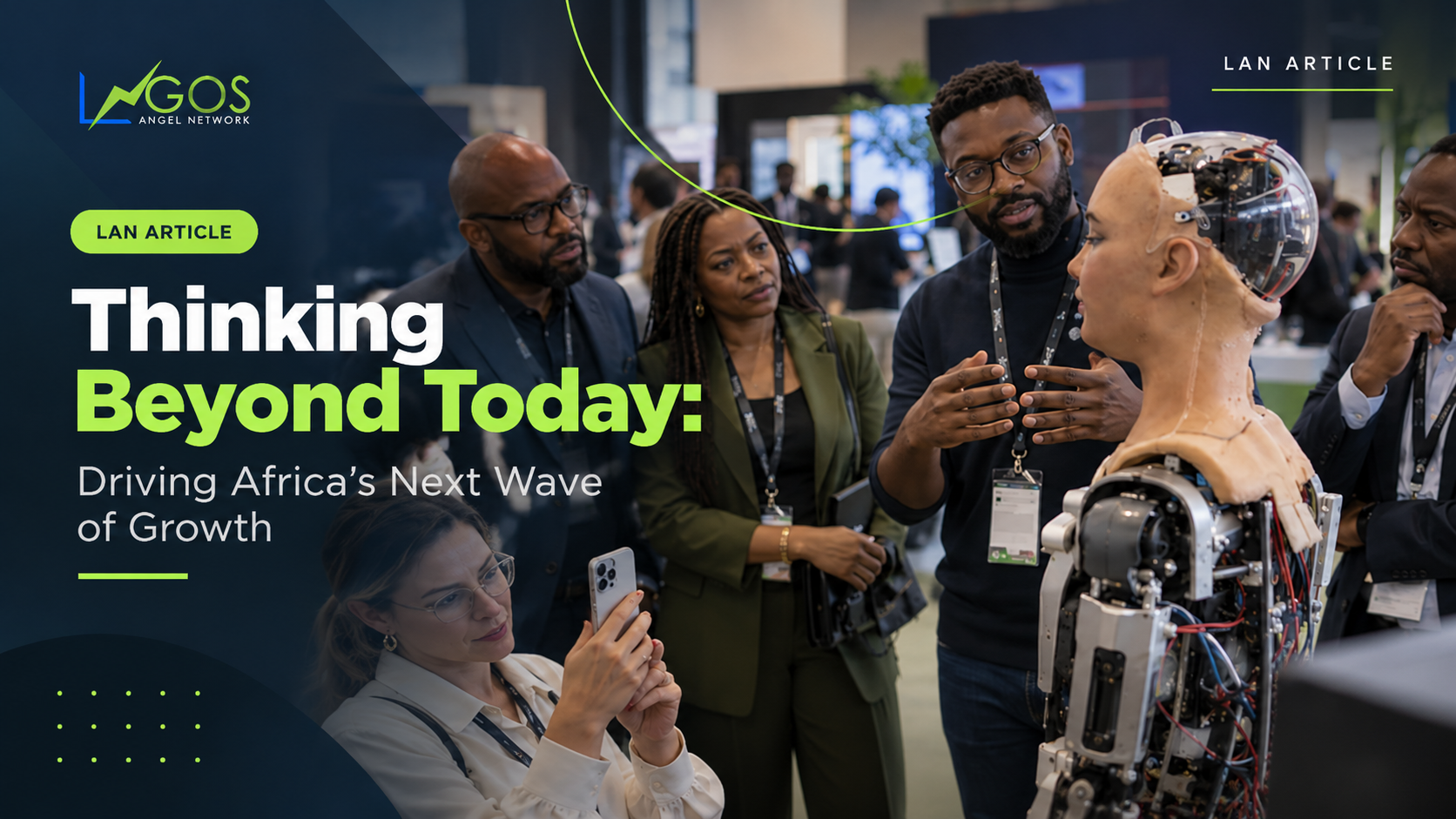
As angel investors, we spend considerable time evaluating the businesses being built today. But how often do we stop to consider the world those businesses will have to operate in tomorrow?
At the Lagos Angel Network, we concern ourselves with the future of the ecosystem, the markets and Africa’s innovation itself. This matters because early-stage investing is fundamentally an exercise in looking ahead. We are backing businesses at a point when their markets may still be developing, their models are being tested, and the conditions that will determine their long-term success are not yet fully established.
When evaluating an early-stage business, we naturally ask: Is the founder capable? Is the problem worth solving? Is there a market? Is there traction? Can the business model support growth? These questions are necessary. But there is another that deserves just as much attention: what happens to this business as the market evolves?
Building Something New Is Not the Same as Building Something That Will Matter
There is a distinction worth making between novelty and lasting relevance. A company can be solving a genuine problem, showing real traction, and still face a future where the conditions that made it successful begin to shift. The problem gets solved differently. The cost of delivery falls. Consumer behaviour moves on. The real question is not whether the business is working today, it is whether it will continue to matter tomorrow.
The way people discover, buy, and access things is shifting faster than most business models are being built to accommodate. The businesses raising today will have to operate in that world, not the one that exists now.
So beyond the founder, the traction, and the projections, the question worth asking is: will the underlying customer need persist, and is this business building an advantage that can endure, or is it benefiting from a temporary gap that the market will eventually close?
What This Means for Angel Investors
Angel investors operate in a part of the market where uncertainty is unavoidable. Many businesses they evaluate have limited operating histories, modest revenues or models that have not yet been tested at scale. Investment decisions therefore involve forming a view about what a company could become, not simply assessing what it has already achieved.
That makes future relevance an important consideration alongside the fundamentals. Founder capability, market size, traction, unit economics and the path to profitability remain essential. But they need to be interpreted in context.
A large market today does not automatically translate into a large opportunity tomorrow. Strong traction demonstrates that customers want a product now — but investors still need to understand what sustains that demand over time. There is also a direct connection to returns: if expectations about a business’s future value do not account for how the market may change, they may overestimate the durability of the opportunity.
The task is to assess whether a business can become more relevant as the world changes, and whether that relevance can translate into the growth and returns we are investing for.
The African Innovation Question
These considerations raise a broader question for the African startup ecosystem: how seriously are we thinking about the future of the markets we are building in?
Across Nigeria and the continent, entrepreneurs are working to solve problems in financial services, healthcare, agriculture, logistics, education and energy. Many operate in markets where infrastructure gaps and distribution challenges create significant opportunities. But these markets are not static. Payments infrastructure develops. Consumer behaviour shifts. Connectivity expands unevenly. Regulations evolve. The pace and direction of these changes will influence which opportunities emerge, which business models become viable and which companies can grow sustainably.
This calls for a broader conversation about the future of Africa’s innovation. What kinds of businesses will become increasingly important as our markets evolve? Which problems will persist, and which may be addressed through new infrastructure or fundamentally different approaches? How might changes in technology and consumer behaviour reshape the sectors attracting investment today?
These are not questions any single investor can answer alone. They require perspectives from founders, investors, operators and researchers across the ecosystem. As an ecosystem, we cannot afford to treat these conversations as occasional exercises.
Thinking Beyond the Investment Decision
At Lagos Angel Network, our interest in the future of innovation is closely connected to the work of evaluating and supporting early-stage businesses. The companies we assess today are being built for markets that will continue to evolve long after the initial investment decision has been made.
No investor can know precisely what a market will look like in five or ten years. The objective is not to eliminate uncertainty, it is to engage with it more deliberately. To ask better questions, challenge assumptions and recognise that a business’s long-term potential depends partly on how the world around it develops.
When we invest early, we are not only betting on what a business can become. We are betting on whether the world will move in a direction that makes what it is building more valuable.
Thinking beyond today is part of understanding what makes an investment worth making in the first place.
Lagos Angel Network | lagosangelnetwork.net.